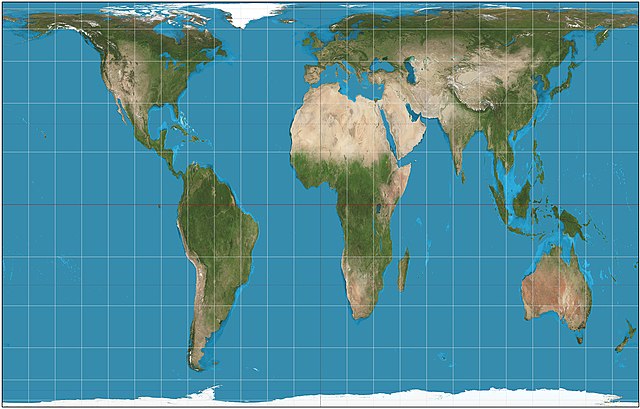
The Peters Projection Map, also known as the Gall-Peters Projection, is a significant cartographic innovation of the 20th century. Developed by German historian Arno Peters in 1973, this map challenged traditional representations of the world and sparked debates about cartographic accuracy, cultural bias, and social justice.
At first glance, the Peters Projection Map may appear similar to traditional maps, with its depiction of continents, oceans, and political boundaries. However, upon closer inspection, it becomes apparent that the proportions of landmasses are distorted compared to conventional maps such as the Mercator Projection.

One of the key features of the Peters Projection Map is its equal area representation, which preserves the relative sizes of landmasses regardless of their latitude. This contrasts with the Mercator Projection, which exaggerates the size of landmasses near the poles and minimizes the size of those near the equator, leading to a distorted perception of the world.
Moreover, the Peters Projection Map has been celebrated for its emphasis on social justice and global equality. By accurately representing the true size of continents such as Africa, South America, and Asia, it highlights the disproportionate representation of Western nations on traditional maps and challenges Eurocentric perspectives of the world.
The Peters Projection Map has sparked widespread debate and controversy since its introduction. Critics argue that while it may provide a more accurate representation of landmasses, its distortion of shapes and distances makes it less practical for navigation and spatial analysis. However, supporters counter that its emphasis on equality and representation outweighs any drawbacks in terms of cartographic precision.
As we reflect on the legacy of the Peters Projection Map, we are reminded of the power of cartography to shape our understanding of the world and influence our perceptions of space, place, and identity. It serves as a reminder of the ongoing quest for accuracy, fairness, and inclusivity in mapmaking and geographic representation.
#PetersProjection #Cartography #Geography #SocialJustice #EqualArea
 æsthetic triangle