
In the vibrant tapestry of medieval cartography, the Vesconte-Sanudo Mappa Mundi stands as a testament to the grandeur and complexity of the maritime republic of Venice. Crafted in the early 14th century by the Venetian nobleman Marino Sanudo and the famed cartographer Pietro Vesconte, this remarkable map offers a unique perspective on the world as seen through the eyes of medieval Venetians. With its intricate details, vivid illustrations, and rich historical context, the Vesconte-Sanudo Mappa Mundi invites us to embark on a journey through time and space, tracing the rise and fall of one of the greatest maritime powers of the Middle Ages.
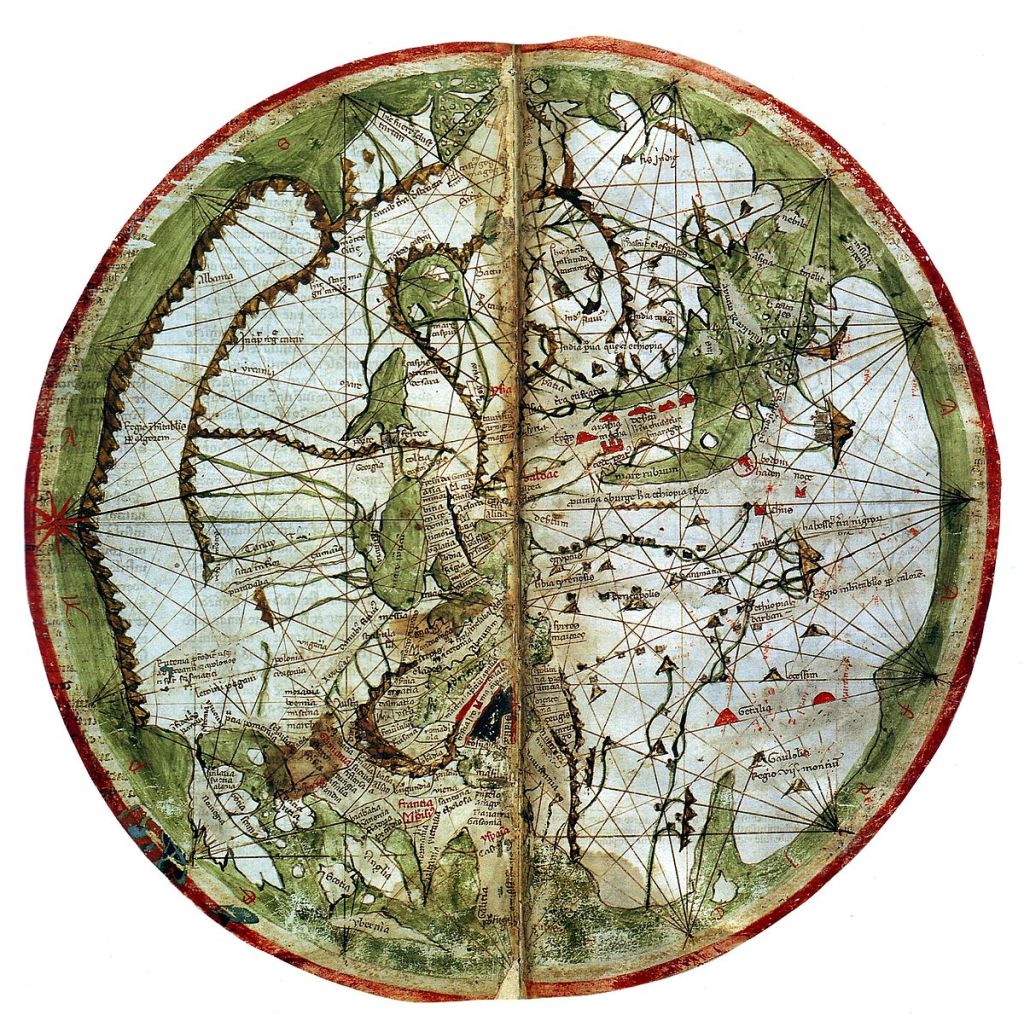
Commissioned by Marino Sanudo, a prominent Venetian nobleman and historian, the Vesconte-Sanudo Mappa Mundi was created at a time when Venice was at the height of its power and influence. As a key player in the Mediterranean trade network, Venice controlled vast territories and dominated maritime commerce between Europe and the East. Eager to document and celebrate Venice’s achievements, Sanudo enlisted the services of Pietro Vesconte, one of the most skilled cartographers of the era, to create a map that would showcase Venice’s glory to the world.
The Vesconte-Sanudo Mappa Mundi is a monumental work of art and cartography, measuring over two meters in length and painted on parchment with exquisite detail. At its center lies the city of Venice, depicted in stunning detail with its iconic network of canals, bridges, and palaces. Surrounding Venice are various regions and kingdoms of Europe, Asia, and Africa, each represented with meticulous accuracy and adorned with colorful illustrations and inscriptions that bring the medieval world to life.
One of the most striking features of the Vesconte-Sanudo Mappa Mundi is its depiction of Venice’s maritime empire and commercial network. From the bustling port of Alexandria in Egypt to the spice markets of Constantinople, the map traces the trade routes and commercial hubs that connected Venice to the wider world. Along these routes are depicted various commodities such as spices, silks, and precious metals, each symbolizing the wealth and prosperity that flowed into Venice’s coffers from its extensive maritime trade.
The Vesconte-Sanudo Mappa Mundi also offers insights into the cultural and political dynamics of medieval Venice. By depicting Venice at the center of the world, the map reflects the city’s self-perception as a cosmopolitan hub of trade and culture, as well as its ambition to project its power and influence across the Mediterranean and beyond. Surrounding regions are portrayed in relation to Venice, with distant lands and mythical realms occupying the outermost edges of the map—a testament to Venice’s global ambitions and imperial aspirations.
Yet, for all its grandeur and ambition, the Vesconte-Sanudo Mappa Mundi also reflects the uncertainties and challenges facing medieval Venice. As the city-state grappled with political intrigue, economic competition, and military conflict, its fortunes ebbed and flowed, leaving an indelible mark on the map and shaping its depiction of the world. From the rise of rival maritime powers such as Genoa and Pisa to the shifting alliances and alliances of the Crusades, the map captures the dynamic and tumultuous nature of medieval geopolitics and the enduring quest for power and prestige.
Today, the Vesconte-Sanudo Mappa Mundi stands as a testament to the enduring legacy of medieval Venice and its contributions to the world of cartography and exploration. Through its intricate details and vivid illustrations, the map offers a captivating glimpse into the world as seen through the eyes of medieval Venetians, inviting us to explore the rich history and cultural heritage of one of the greatest maritime powers of the Middle Ages. As we unravel the secrets of the Vesconte-Sanudo Mappa Mundi, we gain a deeper appreciation for the grandeur and complexity of medieval Venice and its enduring legacy in the annals of world history.
#Venice #MedievalMaps #VesconteSanudo #MappaMundi #Cartography
 æsthetic triangle