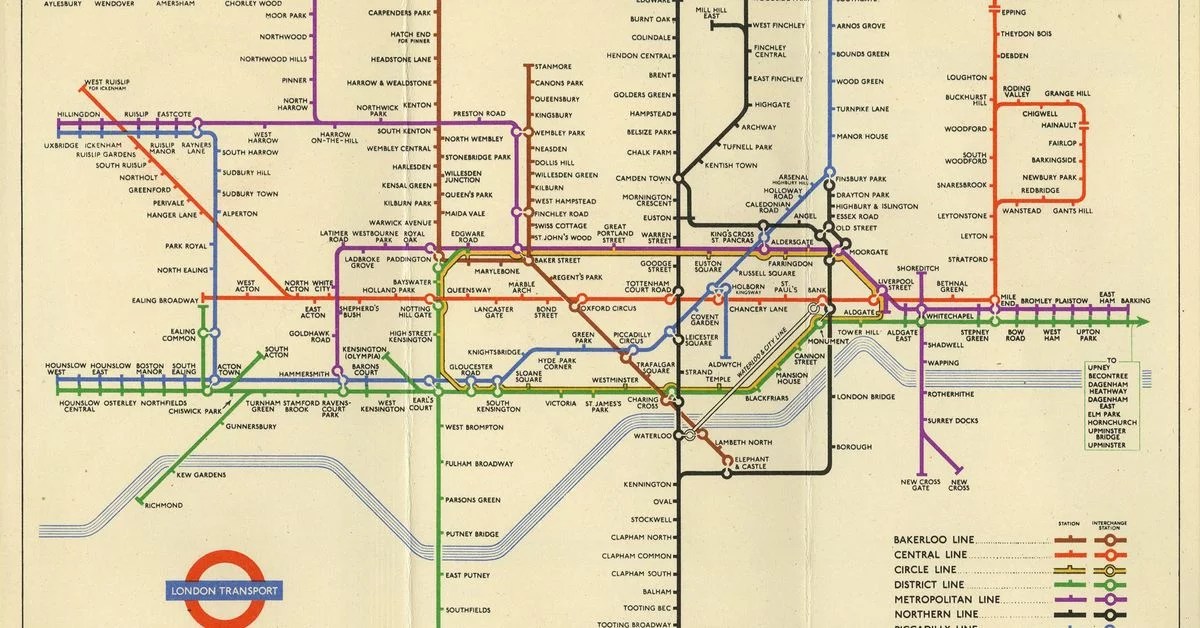
In the realm of urban cartography, few innovations have had as profound an impact as the London Tube Map. Crafted in the early 20th century by the electrical draftsman Harry Beck, this iconic map transformed the way we navigate and understand complex urban environments. With its innovative design, clear visual hierarchy, and user-friendly layout, the London Tube Map revolutionized urban transportation and set a new standard for subway maps around the world.
The history of the London Tube Map is a tale of innovation, ingenuity, and necessity born out of the rapid expansion of London’s underground railway network. As the city grew rapidly in the late 19th and early 20th centuries, so too did its transportation infrastructure, leading to the development of an extensive network of underground tunnels and railway lines. By the early 20th century, navigating this labyrinthine system had become increasingly challenging for commuters, with traditional maps failing to accurately represent the complex interconnections and overlapping routes of the underground network.

Enter Harry Beck, a young electrical draftsman working for the London Underground. Faced with the task of designing a new map to help passengers navigate the expanding subway system, Beck approached the problem with fresh eyes and innovative thinking. Drawing inspiration from electrical circuit diagrams, Beck devised a radical new design that replaced geographical accuracy with spatial clarity, emphasizing the relative positions and connections of stations rather than their actual distances and locations above ground.
In 1931, Beck’s groundbreaking design was unveiled to the public—a bold departure from traditional cartographic conventions that sparked controversy and skepticism among transportation officials and mapmakers. Instead of a geographically accurate representation of London’s streets and landmarks, Beck’s map featured a simplified, diagrammatic layout that emphasized the subway lines and stations, with straight lines and right angles replacing the meandering curves and irregular shapes of traditional maps.
Despite initial resistance, Beck’s map was an instant success, winning over commuters with its intuitive design and user-friendly layout. By simplifying the complex network of subway lines into a series of interconnected colored lines, Beck’s map made it easy for passengers to plan their journeys and navigate the underground system with confidence. Moreover, by abstracting the geographical reality of London’s streets and landmarks, Beck’s map emphasized the functional utility of the subway network, transforming it from a confusing maze into a coherent and accessible transportation system.
Over the decades that followed, the London Tube Map underwent numerous revisions and updates, reflecting changes in the subway network and technological advancements in cartography and graphic design. Yet, Beck’s original design principles remained at the core of the map’s success, inspiring generations of mapmakers and urban planners around the world to rethink the way they represent complex urban environments.
Today, the London Tube Map stands as a timeless symbol of innovation and ingenuity—a testament to the power of design to transform the way we navigate and understand the world around us. From its humble beginnings as an electrical draftsman’s sketch to its status as an iconic symbol of London’s transportation system, the Tube Map continues to captivate and inspire people around the world, reminding us of the profound impact that a simple map can have on our daily lives.
Whether the millions who’ve used it are aware of it or not, the London Tube Map represents a paradigm shift in urban cartography—a revolutionary design that transformed the way we navigate complex urban environments. Through its innovative layout, clear visual hierarchy, and user-friendly design, the Tube Map revolutionized urban transportation and set a new standard for subway maps around the world. As we celebrate the legacy of Harry Beck’s groundbreaking design, we are reminded of the power of innovation and creativity to shape the world around us and improve the lives of millions of people.
#LondonTube #UrbanTransportation #HarryBeck #TransitMaps #CartographicInnovation
 æsthetic triangle