
Crafted over three millennia ago in the cradle of civilization, the Babylonian Map offers a remarkable glimpse into the geographical knowledge and cosmological beliefs of the ancient Mesopotamians. With its rudimentary depictions and symbolic representations, the Babylonian Map of the World provides valuable insights into how the ancients viewed their place in the cosmos and understood the world around them.
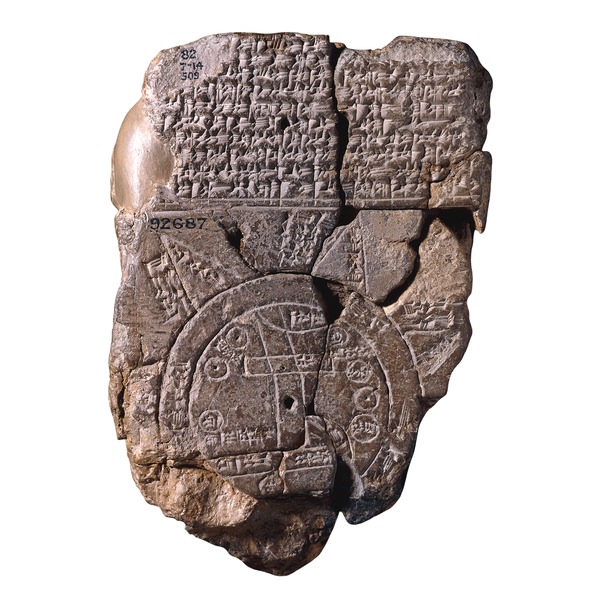
Created during the reign of the Babylonian king Ashurbanipal in the 7th century BCE, the Babylonian Map of the World is one of the oldest surviving maps in existence. Carved onto a clay tablet measuring approximately 12 by 8 inches, the map depicts the known world of the time from a bird’s-eye perspective, with Babylon at its center. Surrounding Babylon are various regions and landmarks, including rivers, mountains, and cities, each represented by stylized symbols and inscriptions.
At the heart of the Babylonian Map of the World lies the city of Babylon itself, depicted as a circular walled enclosure with the Euphrates River flowing through its center. Surrounding Babylon are other regions of the ancient Near East, such as Assyria, Elam, and Persia, each represented by geometric shapes and inscriptions. Beyond these regions lie the “Land of the Living,” a mythical realm inhabited by gods, demons, and other supernatural beings.
One of the most striking features of the Babylonian Map of the World is its symbolic representation of geographical features and celestial bodies. Rivers are depicted as wavy lines, mountains as triangular shapes, and cities as circular enclosures with dots or lines representing buildings. In addition to these terrestrial features, the map also includes depictions of celestial bodies such as the sun, moon, and stars, each associated with specific deities and celestial phenomena.
Yet, for all its simplicity and symbolic representations, the Babylonian Map of the World offers valuable insights into the ancient Mesopotamian worldview and their understanding of geography and cosmology. By depicting Babylon at the center of the world, the map reflects the political and cultural importance of the city as the capital of the Babylonian Empire and the center of Mesopotamian civilization. Surrounding regions are portrayed in relation to Babylon, with distant lands and mythical realms occupying the outermost edges of the map.
The Babylonian Map of the World also provides evidence of the ancient Mesopotamians’ interest in astronomy and celestial phenomena. By including depictions of celestial bodies and their movements, the map reflects the Mesopotamians’ belief in the interconnectedness of the heavens and the earth, as well as their desire to understand the cosmic forces that governed the universe.
This map is a fascinating glimpse into the ancient Mesopotamian worldview and their understanding of geography and cosmology. Despite its simplicity and symbolic representations, the map provides valuable insights into how the ancients viewed their place in the cosmos and understood the world around them. As we unravel the mysteries of the Babylonian Map of the World, we gain a deeper appreciation for the cultural and intellectual achievements of ancient Mesopotamia, as well as their enduring legacy in the history of cartography and geographical inquiry.
#AncientMaps #Mesopotamia #BabylonianHistory #Cartography #Geography
 æsthetic triangle