
The Kangnido Map stands as a testament to the cultural exchange and intellectual achievement of the Joseon Dynasty in 15th century Korea. Commissioned by King Sejong the Great, this remarkable atlas offers a comprehensive depiction of the known world at the time—a synthesis of geographical knowledge from East and West that reflects Korea’s position as a center of cross-cultural exchange and innovation. Through its intricate details and cosmopolitan outlook, the Kangnido Map invites viewers to embark on a journey of exploration and discovery, tracing the contours of a world in transition.
Crafted in 1402 by the Korean cartographer Kim Sa-hyeong, the Kangnido Map is renowned for its unique blend of Eastern and Western cartographic traditions. At its center is a world map, surrounded by smaller maps of Asia, Africa, and Europe, each adorned with colorful illustrations and detailed geographical features. From the majestic mountains of the Himalayas to the bustling markets of Baghdad, the map captures the diversity and richness of the known world with remarkable precision and artistic beauty.
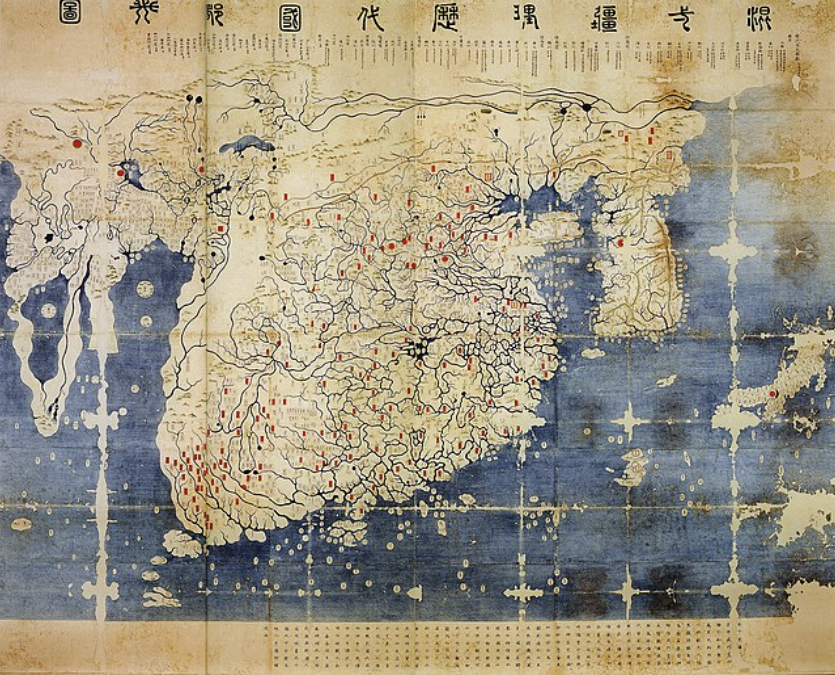
One of the most striking features of the Kangnido Map is its depiction of East Asia, which reflects Korea’s central position in the region and its cultural and diplomatic ties with neighboring countries. The map provides detailed representations of Korea, China, and Japan, as well as neighboring regions such as Manchuria and Mongolia. Through its meticulous craftsmanship and geographical accuracy, the map offers valuable insights into the political, economic, and cultural landscape of East Asia during the Joseon Dynasty, highlighting Korea’s role as a regional power and center of civilization.
Equally impressive is the Kangnido Map’s depiction of the wider world, which reflects Korea’s engagement with global trade and exploration. From the Silk Road to the Indian Ocean, the map traces the routes of trade and communication that connected East Asia to the wider world, including the Arab world, India, and Southeast Asia. Through its detailed illustrations and descriptive texts, the map offers a comprehensive overview of the global networks of exchange and interaction that shaped the medieval world, highlighting Korea’s position as a hub of maritime commerce and cultural exchange.
The Kangnido Map’s depiction of Europe is particularly noteworthy for its accuracy and detail, drawing on the latest geographical knowledge available at the time. The map includes representations of major European cities such as Rome, Paris, and Constantinople, as well as geographical features such as rivers, mountains, and coastlines. While some aspects of the map’s portrayal of Europe may be speculative or based on hearsay, it nonetheless offers valuable insights into medieval perceptions of the Western world and the cultural exchange between East and West.
Yet, for all its geographical accuracy and artistic beauty, the Kangnido Map also reflects the cultural and political context of its time. Commissioned by King Sejong the Great, the map served not only as a tool for navigation and exploration but also as a symbol of Korean identity and imperial ambition. By depicting Korea as a central and powerful kingdom at the heart of the known world, the map reinforced the Joseon Dynasty’s claims to legitimacy and authority, while also celebrating Korea’s cultural achievements and contributions to civilization.
The legacy of the Kangnido Map extends far beyond the confines of its parchment pages. As a symbol of Korean innovation and cultural exchange, it continues to inspire scholars, artists, and historians alike, offering a window into the dynamic and cosmopolitan world of medieval Korea. Through its intricate details and cosmopolitan outlook, the map serves as a reminder of Korea’s rich cultural heritage and its enduring legacy of cross-cultural exchange and innovation. As we explore the illuminated pages of the Kangnido Map, we gain a deeper appreciation for the interconnectedness of cultures and civilizations and the timeless quest for knowledge and understanding that unites us all.
 æsthetic triangle