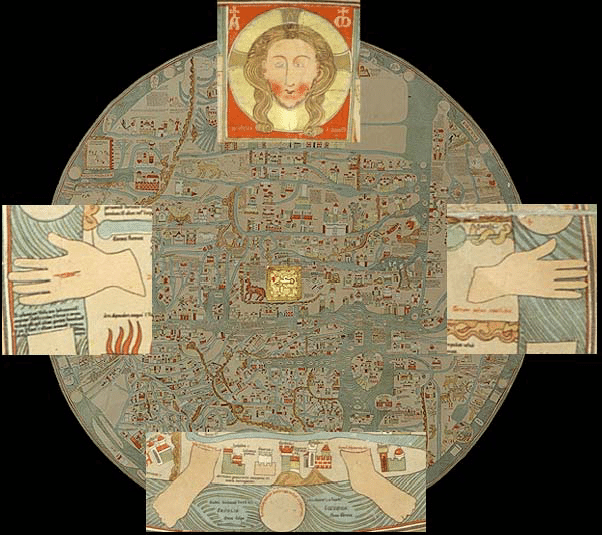
In the rich tapestry of medieval cartography, the Ebstorf Map stands as a remarkable artifact that embodies the intellectual and spiritual aspirations of the Middle Ages. Created in the 13th century by unknown artisans in the Benedictine convent of Ebstorf, Germany, this monumental mappa mundi (world map) offers a captivating glimpse into the medieval worldview—a cosmos teeming with wonders, mysteries, and religious symbolism. With its intricate details and allegorical imagery, the Ebstorf Map invites viewers to embark on a journey through time and space, exploring the medieval cosmos and the intricate interplay between theology, geography, and imagination.
Measuring over 3.5 meters in diameter, the Ebstorf Map is one of the largest surviving medieval world maps, crafted on 30 individual calfskins stitched together to form a single, circular canvas. Its center is occupied by a symbolic representation of Christ, with his arms outstretched in a gesture of divine blessing, surrounded by concentric circles that depict the Earth, the heavens, and the celestial spheres. Radiating outward from this central motif are depictions of continents, oceans, cities, and landmarks, each imbued with rich symbolism and allegorical meaning.
At first glance, the Ebstorf Map may appear bewildering to modern eyes, with its stylized depictions of geography and its blending of empirical observation with religious symbolism. Unlike modern maps that prioritize geographical accuracy and scientific precision, the Ebstorf Map is a product of its time—a reflection of the medieval worldview shaped by Christian theology, classical learning, and folk traditions. Through its intricate details and allegorical imagery, the map seeks to convey not just physical geography but also spiritual truths and moral lessons, inviting viewers to contemplate the mysteries of creation and the divine order of the cosmos.
One of the most striking features of the Ebstorf Map is its depiction of the inhabited world, which is divided into three continents—Asia, Europe, and Africa—surrounded by the encircling waters of the ocean. Each continent is populated with cities, rivers, and mountains, as well as mythical creatures, biblical scenes, and historical events that reflect the cultural and religious beliefs of the medieval period. From the Tower of Babel to the Garden of Eden, the map is replete with biblical references and religious symbolism that serve to reinforce the Christian worldview and the providential role of God in human history.
Equally fascinating are the map’s depictions of the celestial spheres and the heavenly hierarchy that governs the universe. Surrounding the Earth are the concentric circles of the heavens, inhabited by angels, saints, and celestial beings that oversee the workings of the cosmos. At the top of the map, Christ sits enthroned in glory, surrounded by the heavenly host, while below him are depictions of the zodiac, the planets, and the signs of the zodiac, each associated with cosmic significance and astrological symbolism.
Yet, for all its religious symbolism and allegorical imagery, the Ebstorf Map also serves as a testament to the medieval quest for knowledge and understanding of the natural world. Through its depiction of geography, astronomy, and cartography, the map reflects the intellectual curiosity and scientific inquiry of the Middle Ages, as well as the desire to map and comprehend the complexities of the world around them. While its geographical accuracy may be limited by modern standards, the map nonetheless offers valuable insights into the medieval worldview and the intricate interplay between faith, reason, and imagination.

In sum, this Map is a captivating artifact that offers a window into the medieval cosmos and the intricate interplay between theology, geography, and imagination. Through its intricate details and allegorical imagery, the map invites viewers to contemplate the mysteries of creation and the divine order of the cosmos, while also reflecting the intellectual curiosity and scientific inquiry of the Middle Ages. As we explore its rich symbolism and cultural significance, we gain a deeper appreciation for the enduring legacy of medieval cartography and the timeless quest for knowledge and understanding of the world.
#EbstorfMap #MedievalCosmography #Cartography #History #Religion
 æsthetic triangle