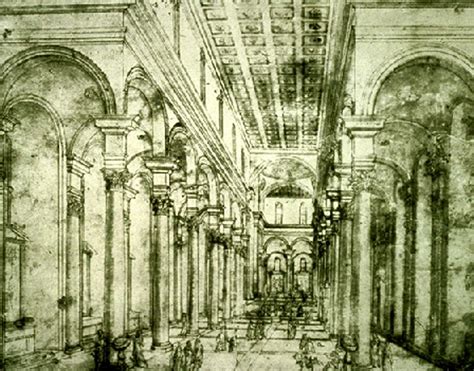
The Renaissance period marked a transformative era in the history of art, characterized by a renewed interest in classical antiquity and a departure from medieval artistic conventions. One of the significant developments during this period was the evolution of perspective, a technique that revolutionized the way artists represented space and depth in their works.

Prior to the Renaissance, medieval art predominantly employed a flat and symbolic approach to space, often depicting figures and scenes in a two-dimensional manner. However, with the revival of classical knowledge and the study of ancient texts, artists such as Filippo Brunelleschi and Leon Battista Alberti began to explore mathematical principles to achieve a more realistic depiction of space.
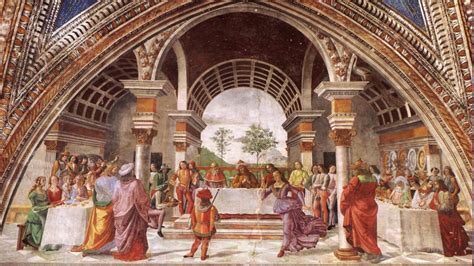
Brunelleschi, renowned for his architectural innovations, conducted experiments with linear perspective in the early 15th century. His studies laid the foundation for a systematic approach to representing three-dimensional space on a two-dimensional surface. Alberti, a polymath of the Renaissance, further codified these principles in his treatise “De Pictura,” providing artists with a comprehensive guide on perspective, proportions, and composition.

Linear perspective became a cornerstone of Renaissance art, enabling artists to create more naturalistic and immersive scenes. The technique involved the use of converging parallel lines and a vanishing point to create the illusion of depth and distance. This newfound understanding of perspective allowed artists like Masaccio, Leonardo da Vinci, and Raphael to masterfully depict realistic architectural settings and lifelike human figures in their paintings.
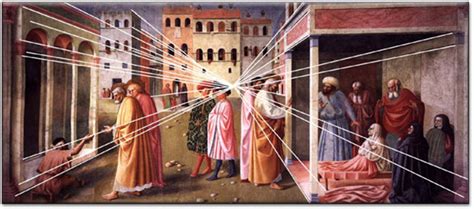
The impact of perspective extended beyond mere technical prowess; it transformed the viewer’s experience of art. Paintings became windows into meticulously crafted worlds, inviting viewers to engage with scenes on a deeper, more visceral level. The Renaissance’s embrace of perspective not only revolutionized artistic representation but also paved the way for the development of new visual languages that would influence art for centuries to come. The evolution of perspective in Renaissance art remains a testament to the era’s commitment to innovation and the pursuit of a more accurate reflection of the natural world.
 æsthetic triangle