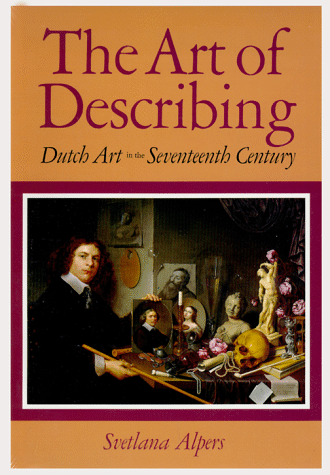
Svetlana Alpers’s seminal work offers an important exploration of Dutch art during the Golden Age. Alpers focuses the Dutch painting tradition that reflects and develops a rich visual culture. As Alpers states “[t]he Dutch present their pictures as describing the world seen rather than as imitations of significant human interactions.” Paintings to be seen versus read.

Through a careful examination of paintings and texts from the period, Alpers unveils the intricate relationship between language and visual representation.
Alpers’s nuanced examination sheds light on how Dutch artists engaged with the world around them as it was lived. This practice allowed painters to create directly for their markets versus through patronage or commissions alone. Similarly, focusing their artistic vision on the larger world they were themselves a part of, argues Alpers, Dutch artists contributed significantly to the rise of Dutch maps that were internationally renowned for their quality – particularly in the 16th and 17th centuries. Examples of the quality of Dutch maps are seen in some of Vermeer’s works. See also Vermeer’s Maps https://shop.frick.org/vermeers-maps.
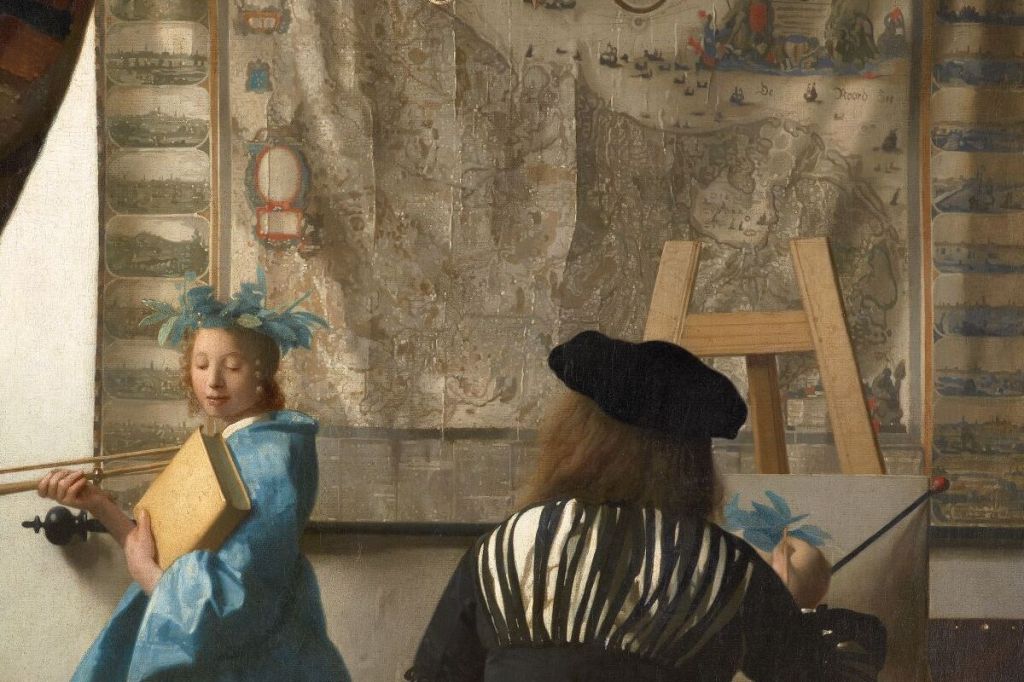
The Art of Describing is not only an insightful exploration of Dutch art but also a compelling argument for seeing versus reading imagery. That The Art of Describing, was published in paperback 1983 is demonstrative of Alpers’s prescience. In our current era of image-driven social media drawn from ‘life experiences’, the Dutch painters of Alpers’s book were centuries ahead of their time. Perhaps this is, in part, why their work continues to captivate us.
For a copy of The Art of Describing see: https://press.uchicago.edu/ucp/books/book/chicago/A/bo5970321.html
 æsthetic triangle